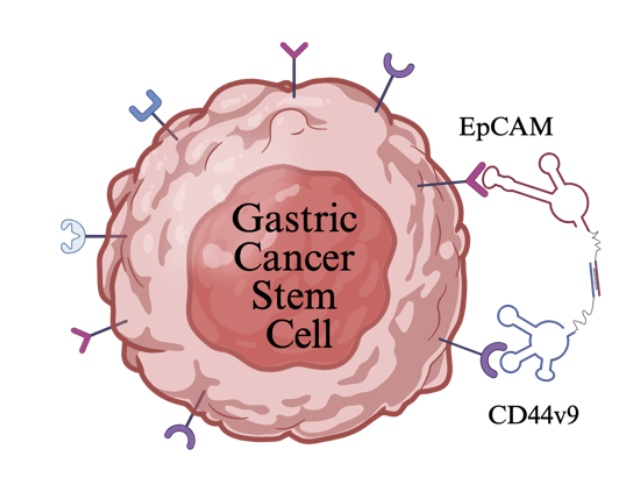
Project title. Dual targeting of gastric cancer stem cells using aptamer-based nanomedicines
Starting Date. March 1st, 2026 (18 months)
Keywords. Aptamer design, cancer targeting, bispecifics.
Project description.
Gastric cancer (GC) is the fourth leading cause of cancer-related deaths worldwide. The prognosis remains poor with a 5-year survival rate of less than 4% for metastatic forms. Pr Varon has deciphered the crucial role of cancer stem cells (CSC) in cancer resistance, relapse and metastasis, and identified specific biomarkers (e.g., EpCAM and CD44 epithelial variants) that are overexpressed in CSC and poorly expressed in non-CSC epithelial cells. This project is aimed at developing a dual targeted chemotherapy for gastric CSC. Aptamers are nucleic acid sequences that are selected to bind their cognate target with high specificity and affinity. Dr Leblond Chain has recently assembled aptamers to exhibit both targeting and drug carrier properties.
This project is aimed at designing aptamer nanoassemblies to improve gastric cancer treatment via the dual targeting of cancer stem cells and the delivery of a programmed combination of drugs. Currently, a PhD student has initiated the project and has validated the aptamers for each receptor (EpCAM and CD44v9), as well as optimized their bispecific assemblies. The in vivo targeting properties are currently in progress as well as the in vitro evaluation of drug-aptamer conjugates.
This post-doc opportunity is focused on the optimization of multivalent aptamers for specific targeting of gastric CSC. Indeed, the affinity of aptamers for their target cells can be increased by cooperativity on the surface of the cell, exploiting the overexpressed receptors. In addition, multivalent aptamers allow the conjugation of aptamers with distinct targets. Therefore, LYTAC aptamers could be designed to trigger receptor degradation of overexpressed GCSC receptors. Such innovative nucleic acid systems will be designed in ARNA laboratory and evaluated on BRIC in vitro 2D and 3D GC cell models. Finally, chemical modifications of aptamers to optimize conjugation stability of in vivo lifetime should be envisaged and evaluated.
Supervision and environment. This project is in close collaboration between the ARNA research group “Targeted Aptamers, Medicines and Sensing”, led by Dr Jeanne Leblond Chain (www.tams.cnrs.fr), and BRIC Team 4 “Helicobacter-associated digestive cancers, cancer stem cells and therapeutic strategies” led by Pr Christine Varon (https://www.bricbordeaux.com/bric-team/equipe-4-cancers-digestifs-associes-a-linfection-par-helicobacter-cellules-souches-cancereuses-et-strategies-therapeutiques/)
The candidate will be supervised by Dr Jeanne Leblond Chain (INSERM Senior researcher, ARNA U1212) in collaboration with Christine Varon (Professeur University of Bordeaux, BRIC). It will take place mainly in the Bordeaux Biologie Santé building in Carreire campus (146 avenue Leo Saignat, 33076 Bordeaux).
Candidate profile. The Post-doc candidate should have a background in aptamer/nucleic acid design, synthesis, biophysics, nanomedicine and/or biochemistry. An experience in cell culture and in vivo experiments is an asset. We are looking for a candidate motivated by the discovery of multi-disciplinary research, ranging from nucleic acid chemistry, molecular biology, cell biology, typical of the chemistry-biology interface.
Contact. Please send your CV, grade record (Master + PhD), PhD report, motivation letter and 2
reference names/letters to jeanne.leblond-chain@inserm.fr before December 20th, 2025.